NEW BOOK
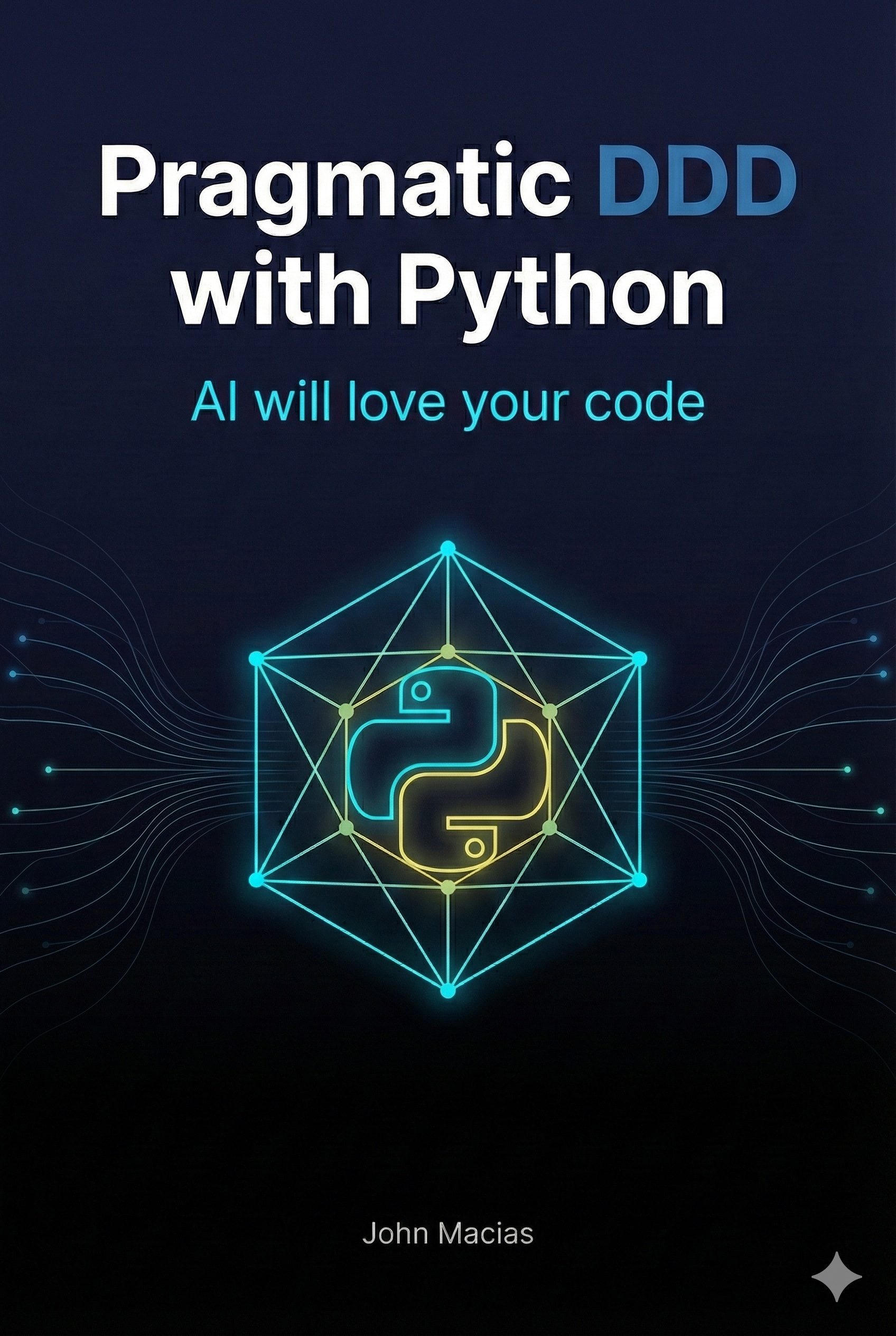
Pragmatic DDD with Python
AI will love your code
Master Domain-Driven Design, CQRS, and Hexagonal Architecture with practical Python and FastAPI examples.
Why DDD Matters
Most Python applications start simple but become unmaintainable spaghetti as they grow. Business logic scattered across routes, models, and services. Changes in one place break things elsewhere.
Domain-Driven Design gives you patterns to organize complexity—and AI tools can understand and extend well-structured code.
What You'll Learn
DDD Building Blocks
Entities, Value Objects, Aggregates, Repositories—implement them properly in Python without over-engineering.
CQRS Pattern
Separate reads from writes. Commands, Queries, and Handlers that scale and test beautifully.
Hexagonal Architecture
Ports and Adapters that keep your domain pure. Swap databases, APIs, or frameworks without rewriting business logic.
AI-READY CODE
Why AI Will Love Your Code
Well-structured DDD code isn't just for humans. AI coding assistants understand and extend clean architectures better than spaghetti code.
# AI understands this structure:
@dataclass
class Booking(AggregateRoot):
items: list[BookingItem] = field(default_factory=list)
status: BookingStatus = BookingStatus.PENDING
def add_item(self, product: Product, quantity: int) -> None:
if self.status != BookingStatus.PENDING:
raise CannotModifyConfirmedBooking()
self.items.append(BookingItem(product, quantity))
def confirm(self) -> None:
if self.total_amount() < self.minimum_spend:
raise MinimumSpendNotReached()
self.status = BookingStatus.CONFIRMED
38 Chapters of Practical DDD
From fundamentals to advanced patterns. Real code, real examples, real Python.
PART I-II
Foundations
Why DDD, the three pillars, folder structure, entities, value objects, aggregates.
PART III-IV
Application Layer
Commands, queries, handlers, DTOs, repositories, domain events, external integrations.
PART V-VI
Testing & Contexts
Unit testing, integration testing, bounded contexts, context mapping, external systems.
PART VII-IX
Advanced & AI
Event sourcing, CQRS deep dive, projections, real-world patterns, AI-assisted development.
38
Chapters
15+
Diagrams
100+
Code Examples
4
Appendices
Who Is This Book For?
If you build Python applications and want them to scale without becoming unmaintainable, this book is for you.
Python Developers
Move beyond basic patterns. Learn architecture that handles complexity without fighting the framework.
Tech Leads
Establish architecture patterns your team can follow. Make code reviews easier with clear boundaries.
AI-Forward Teams
Structure code so AI assistants can help effectively. Reduce hallucinations with explicit patterns.
What Readers Say
Early feedback from Python developers and architects.
"The AI argument completely reframes the 'too much boilerplate' objection. If AI writes the boilerplate, who cares?"
Carlos
Junior Python Developer
"This is the first DDD book I've read that feels like it was written by someone who ships on Fridays."
Laura
Tech Lead, 8 years experience
"For Python teams wanting structure beyond basic patterns, this fills a real gap. Best Python DDD guide available."
Miguel
DDD Architect, 15 years experience
"Best compromise for Python teams. The domain layer is truly framework-agnostic."
Andres
Clean Architecture Advocate
"The code examples are production-grade. Real Python 3.10+ code, not pseudocode. Finally validates modern DDD in Python."
Patricia
Senior Python Developer, 12 years
7.7
Average Rating
From 5 early reviewers
Ready to Master DDD with Python?
Get the book and start building maintainable, AI-friendly applications today.